hiroaki
Individual Developer
View all authors

Why Obsidian × Claude Code / Codex Keeps Going Viral — Reading Through the Popular Posts of 2026

· 18 min read
hiroaki
Individual Developer
If this site helped you, please support us with 🌟 ☕️

I use Obsidian, so posts about Obsidian × Claude Code / Codex catch my eye when they come across my timeline. And since the start of this year they have gone viral again and again, every few months. No single new app is at the center of it, yet the same theme keeps taking off.

I wanted to try it in my own Vault, but each post says something slightly different. Some are only about folder structure, some tell you to install the official skills, and some bring in MCP. Reading them piecemeal, I could not tell what to start with, or even whether these were competing approaches at all.

So before starting, I read straight through the posts that took off between January and September 2026 and put them back in chronological order. The conclusion: they are not competing. The core idea has not changed once since January. What changes is only which layer is put in front — the compilation rules, the official skills, Codex, MCP, the CLI. What follows is that map.
Title image reading Obsidian×Claude Code, Codex

Pulling X Ads Numbers via API Requires an Application — A Look at the Ads API Access Form

· 7 min read
hiroaki
Individual Developer
If this site helped you, please support us with 🌟 ☕️

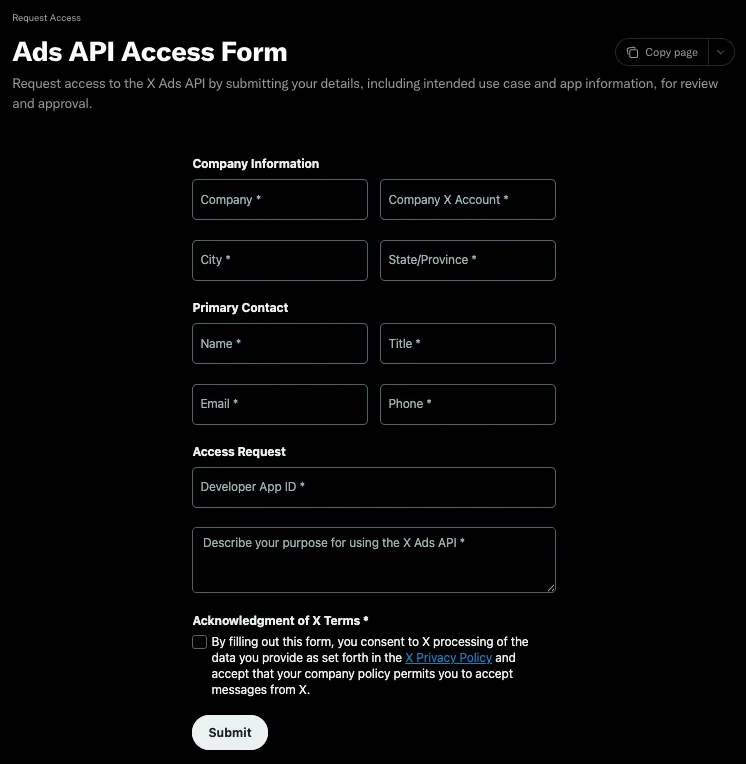
I run small paid campaigns on X (formerly Twitter) for a service I operate on my own, and I had been copying the numbers out of the Ads Manager UI by hand every time. Looking into pulling them via API instead, I found that the X Ads API is a separate, approval-gated program from the regular X API, and using it requires an application. I had assumed API keys were enough, so this caught me off guard.

The form is behind a login, and you cannot tell what it asks for ahead of time. Here is the screen as of September 2026, along with what I put in each field.

The X Ads API Access Form in full, made up of four blocks: Company Information, Primary Contact, Access Request, and the terms acknowledgment

With SQL, the Answer Alone Isn't Enough.

· 14 min read
hiroaki
Individual Developer

Run a SQL query, and you get an answer.

How much revenue did we make?
Which campaign performed best?
How many customers are still active?
Where are users dropping off?

But looking at the number on the screen tells you nothing about why that number is correct.

Which data made it into the aggregate?
What was excluded, and by which condition?
Did a join duplicate rows along the way?
Does the unit of calculation match the metric you actually wanted?

SQL gives you an answer.

To understand how that answer was produced, you have to look beyond the result, at everything that happens on the way there.

Data is no longer something only a handful of specialists touch.

As business operations have become more digital and more data-driven, it is not just engineers and data analysts who are expected to make decisions grounded in data every day. Marketers, product planners, sales teams, and people driving operational improvements are, too.

And behind much of that, out of sight, sits SQL.

SQL Quiz Book is a problem set for understanding how SQL processes data, by mapping each part of a query to the way the table changes.

Warning: How Codex Launched a Local Ollama During a Translation Task — gpt-5.6-sol, Privilege Escalation, and Instruction Boundaries

· 8 min read
hiroaki
Individual Developer
If this site helped you, please support us with 🌟 ☕️

On July 14, 2026, while delegating a large-scale English localization task for content within a development project, Codex started a local Ollama server. There is no evidence that inference or translation was actually performed by Ollama, but the process advanced as far as server startup, GPU detection, and retrieval of the list of locally available models. This post documents what happened and the design considerations worth keeping in mind when delegating long-running, large-scale tasks to a coding agent.

Keeping Claude Code Docs Out of the Public Repo with .git/info/exclude — A Design Log on Exclusion and History Management

· 8 min read
hiroaki
Individual Developer
If this site helped you, please support us with 🌟 ☕️

When I introduced Claude Code into a personal OSS repository I develop and maintain on my own, a requirement emerged: I wanted to keep the AI-related settings and documentation out of the public repository and operate them locally only. In this post, I focus on the two topics I spent the most time considering — the use cases for exclusion settings, and the design of history management, which tends to become scattered in AI-assisted workflows.

Context and Assumptions

The target is a solo-developed (personal OSS) repository, with branch protection requiring PRs and CI already configured on main / develop. Claude Code is used from within the editor, and the main tasks are refactoring, writing articles, and improving features — repetitive work that mostly stays local.

Added "Count-Up" to the Free, Browser-Based Darts Score Calculator (No App or Registration Required)

· 3 min read
hiroaki
Individual Developer
If this site helped you, please support us with 🌟 ☕️
Count-Up Darts Score Calculator Screen

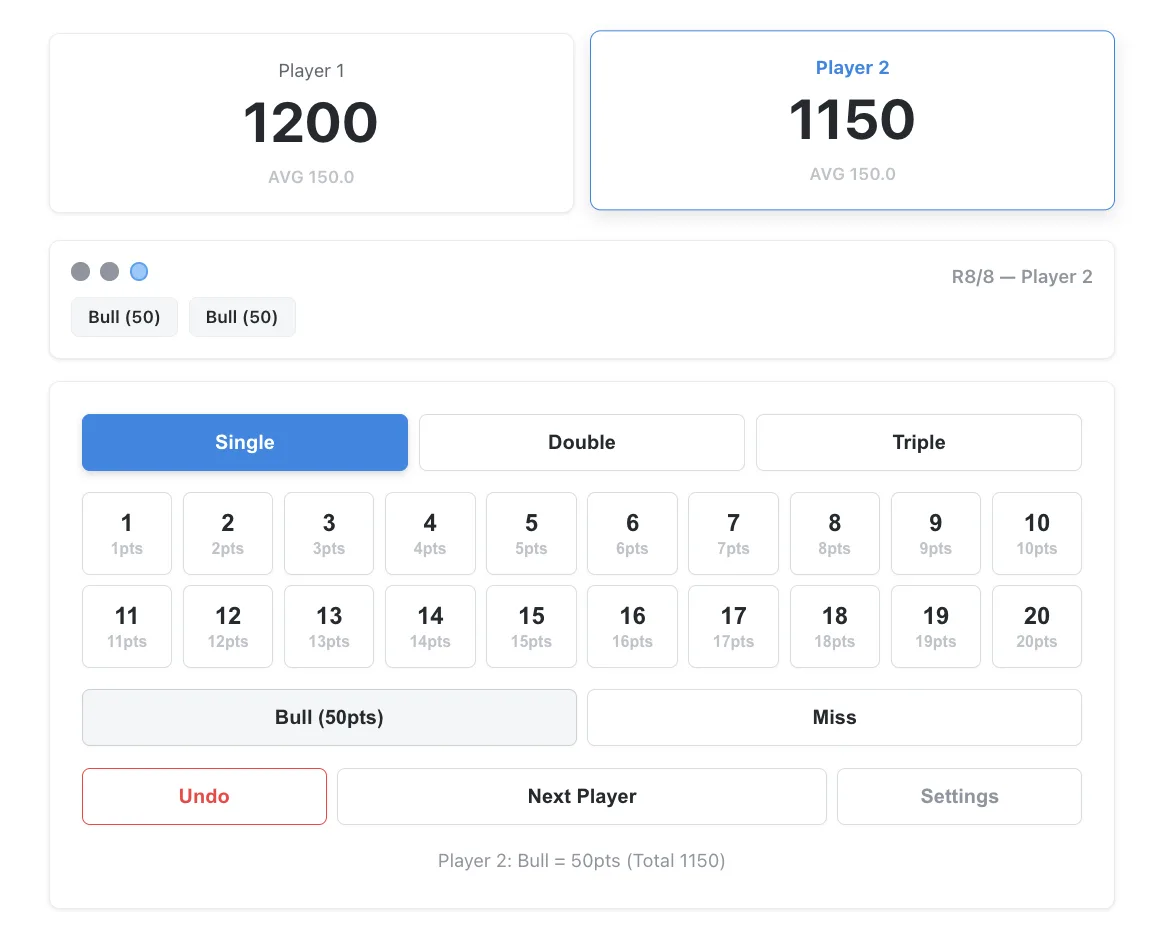
Following the previously released browser-based darts score calculator apps for "01" and "Cricket", we have newly added a "Count-Up" score calculator tool.

While 01 and Cricket are highly strategic and fun games, Count-Up is the best choice for basic darts practice or when playing with beginners who have just learned the rules, as it simply competes for total points. As always, no app installation or account registration is required. You can start using it immediately just by opening your browser.

No Registration or Download Required. Released a Free Darts Calculator (01 & Cricket) Ready to Use in Your Browser.

· 4 min read
hiroaki
Individual Developer
If this site helped you, please support us with 🌟 ☕️
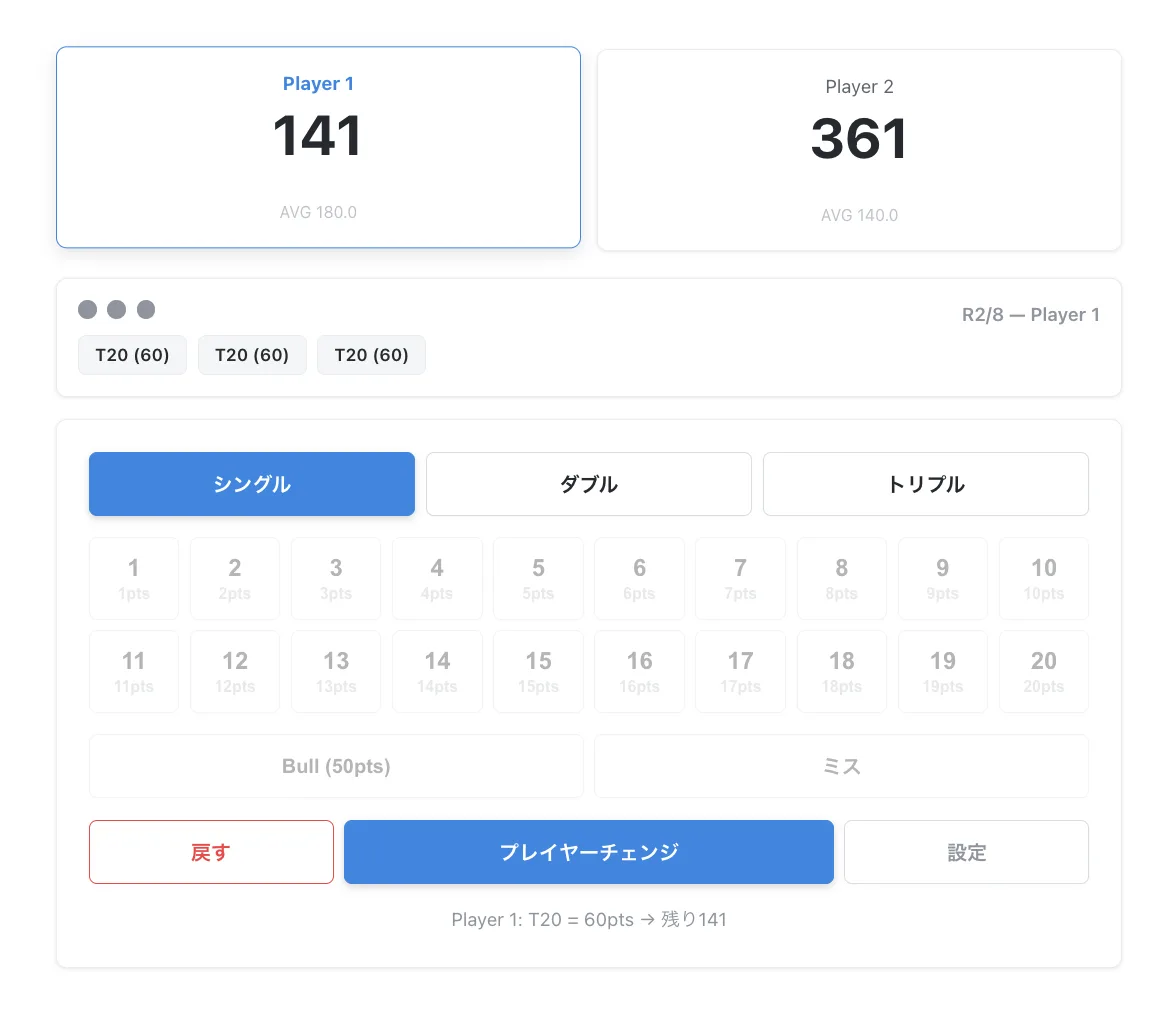
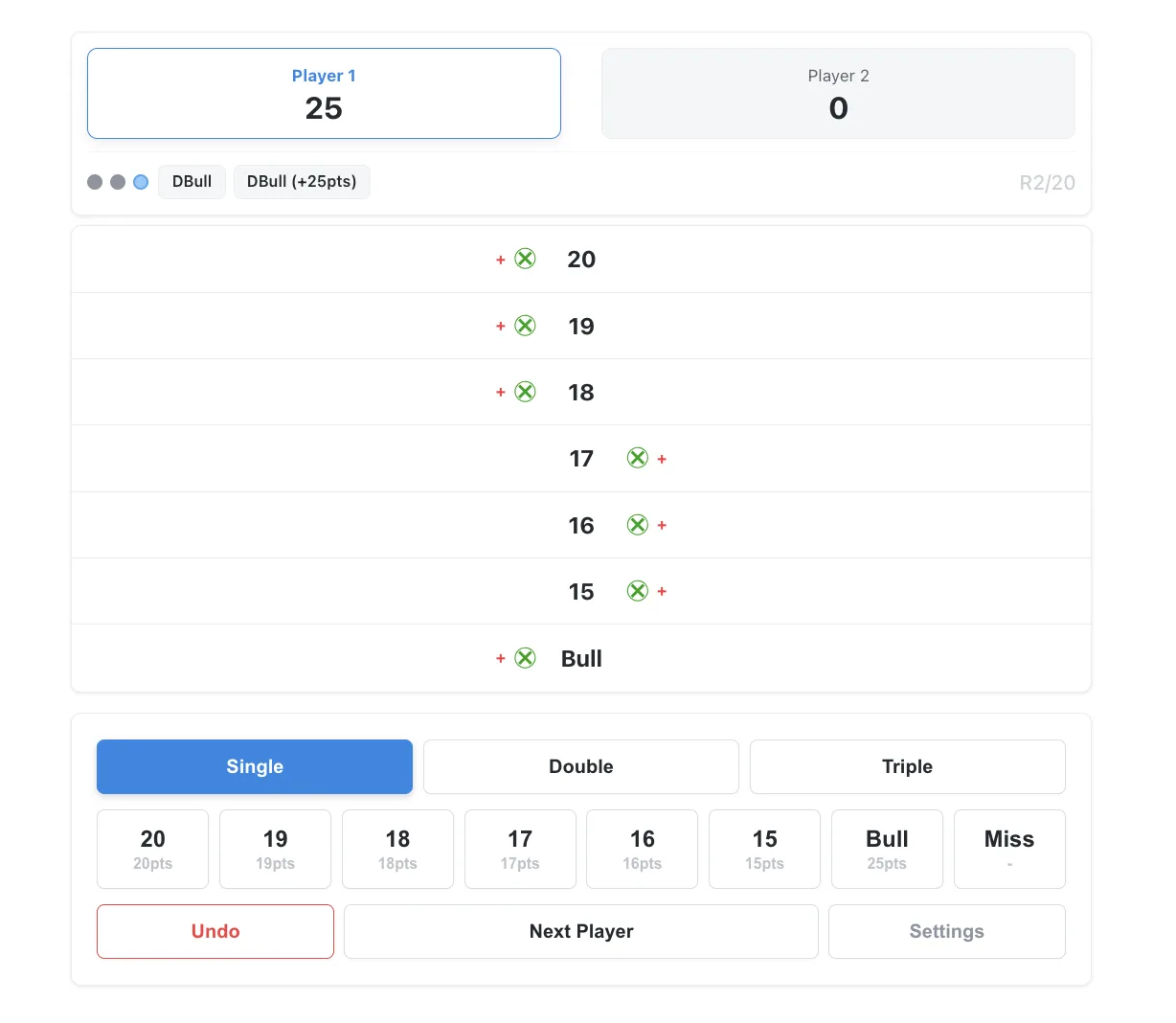
01 Game Darts Score Calculator ScreenCricket Darts Score Calculator Screen

I have a steel tip dartboard at home, and until now, I used to calculate scores in my head while throwing. However, when I played with friends, we needed a proper calculator. When I looked for one, I found that many required installing a smartphone app or creating an account—it was surprisingly hard to find something quick and easy to use.

So, I created a simple "Darts Calculator Web App" that requires no downloads or registration and is ready to use just by opening a browser. I've published it on my personal website. It fully supports score management for the classic 01 (Zero-One) and Cricket games.

Added BGM Feature to Make Demo GIF / MP4

· 3 min read
hiroaki
Individual Developer
If this site helped you, please support us with 🌟 ☕️

Following the recently added zoom feature, we have added a BGM feature to Make Demo GIF / MP4. By adding background music to silent demo videos, you can create more engaging MP4s for your viewers.

The setup steps and usage of this tool are explained in detail in the technical documentation.

I Released a Private LLM Chat Tool That Runs on Google Colab's GPU and Stores No Logs.

· 4 min read
hiroaki
Individual Developer
If this site helped you, please support us with 🌟 ☕️

ChatGPT and Claude are great tools, but do you ever hesitate before typing something work-related or personal into them? On the other hand, setting up a local GPU environment to run Ollama yourself is a steep barrier in terms of both effort and cost.

So I built a private LLM chat environment using Google Colab's free GPU — one that never sends conversation logs outside the instance — and packaged it into a single notebook. Run the cells from top to bottom, and it's ready to go.

The setup steps and usage of this tool are explained in detail in the technical documentation.